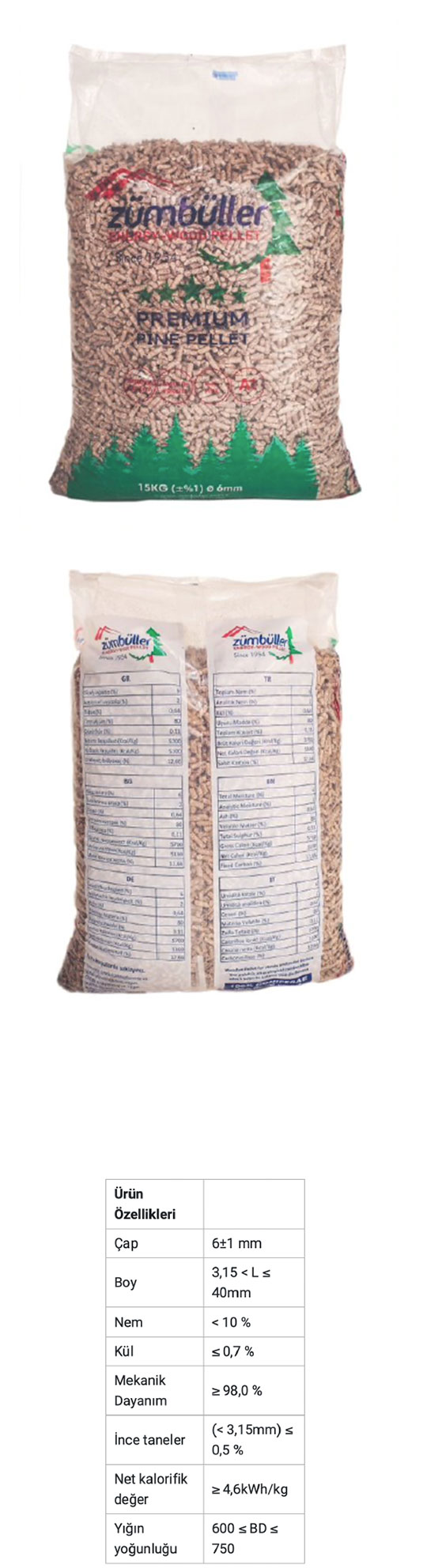
Zümbüller Pellet
Pellet fuel refers to small fuel particles created by grinding and compressing various wood types, wood residues, and forestry waste into sawdust after being pulverized. These particles are pressed under high pressure to obtain energy for the purpose of use. When we realize that our country pays approximately 20 billion dollars annually for fuel needs from abroad, we understand that the energy requirement for fuel is a significant burden for our country. This pellet fuel can be entirely natural and obtained 100% from our country's own resources, making it the most economical and environmentally friendly fuel type for human health in today's conditions.
It not only prevents our country's money from going abroad but also has the potential to provide employment, offering a solution to one of the country's problems. With an investment of almost 1% of the annual amount spent on fuel abroad, it is possible to make a substantial contribution to the country's economy.
PELLET FEATURES
- It has a cylindrical shape.
- Generally, it is in small pieces with a diameter of 6-10 mm and a length of 20-30 mm.
- Wood pellets contain approximately 7-12% moisture. Due to the low moisture content, its calorific value is higher compared to burning wood.
- Calorific value: 4500 kcal/kg.
- Wood pellets are a clean, carbon dioxide-free, and convenient type of fuel.
- Produced from sawdust and wood chips compressed under high pressure, it is 100% natural and does not contain any chemical additives.
- It does not contribute to environmental pollution due to the absence of chemical additives.
- It can be used in all products that include a solid fuel area for heating systems, such as stoves, fireplaces, central heating boilers, and pellet stoves.
- Longer burning time compared to wood.
- High efficiency: 90% (coal efficiency: 65%).
- Air requirement is about 20% of coal.
- Ash content is below one per thousand.
- It does not produce ash.
- It does not cause blockages in chimneys and does not create creosote.
ADVANTAGES OF PELLET
- Rapid development in the combustion systems industry.
- Reducing fossil fuel imports and contributing to the country's economy.
- Produced 100% from domestic resources.
- Sustainability as a renewable resource.
- Acceptable in terms of environmental and human health. Minimal waste after use.
- Less hazardous compared to other fossil fuels.
- Usable in electricity generation.
- Pellet burning systems have the cleanest combustion system among solid fuel systems.
- Wood pellets, a refined biofuel, are available worldwide.
- Easy transportation of wood pellets.
- Requires much less storage space compared to wood.
- No need to cut down trees for commercial pellet production. Pellets utilize forest waste, contributing to forest protection against fires by collecting easily ignitable forest residues.
- Wood pellet heating systems are ozone-friendly and comply with acceptable CO emission threshold values under the Kyoto Protocol.
- In classic solid fuel systems, creosote (tar spirit) is formed in chimneys. Pellet systems have almost no creosote.
- Therefore, it can be exhausted without a chimney (similar to hermetic boilers).
- No poisoning risk like coal.
- Boiler room is free of dust and smoke.
- Lower-capacity motors for reducers and fans result in electricity savings.
- No intervention is required in the boiler room when the power is cut.